

Fashion Diary
Wool-free coat – comparing bouclé, alpaca-style fabrics and synthetic tweed

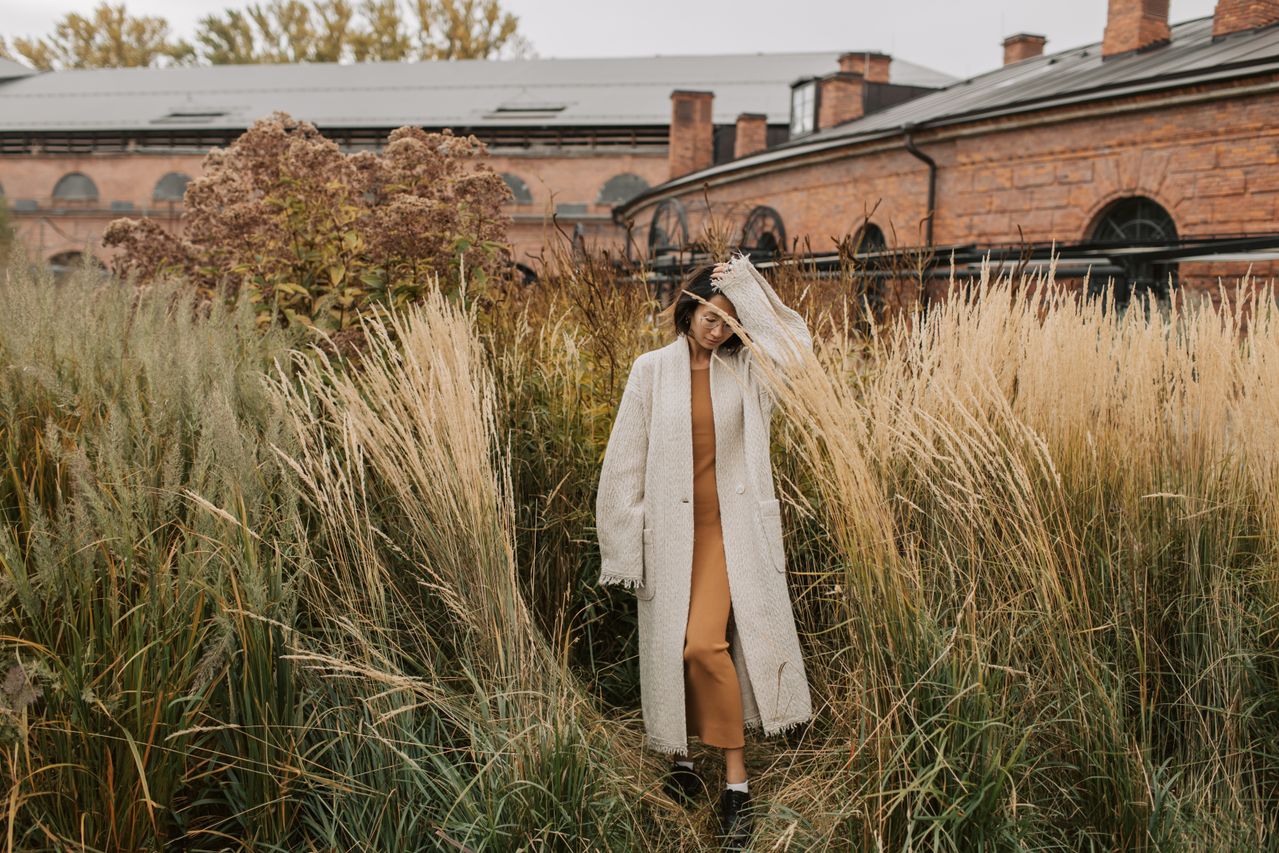
Warmth in a coat comes from the whole garment: the face fabric, the lining, any wadding and how well the finished piece holds back moving air. Here we compare three wool-free materials: a bouclé knit, a micro alpaca-style knit and polyester tweed. What the material itself governs is texture, body and the way a silhouette falls. A wool-free coat is therefore judged by construction, weight and width on the product card.
Three wool-free cards, the essentials:
- Knit or woven: the bouclé and the micro alpaca here are knits, the polyester tweed is a woven cloth with a structured weave.
- Weight and width: all three cards share the same width, and the difference in weight shows up as loft rather than warmth.
- Composition per card: these three specific materials carry no wool, which says nothing about bouclé or alpaca-style ranges as a whole.
- The word “alpaca”: it names a surface type; this card lists 100% polyester.
- Oeko-Tex Standard 100: declared by the tweed card alone, not by all three.
What decides whether a wool-free coat keeps you warm?
Warmth is built by a stack of layers: the face fabric traps air, the lining keeps that air close to the body and a tight finish limits draught. Wind strips insulation from a garment faster than a drop of a few degrees, so a windproof layer underneath changes a coat more than swapping the outer cloth. A warm fabric for coats is only one part of that stack, and weight in GSM tells you no more than how much a square metre weighs.
The choice therefore starts with the garment you have in mind: a light transitional piece or a lined winter one. Coat fabrics run from featherweight early-autumn options to dense cloth meant for winter shapes, so every figure comes from the individual card.
Bouclé, alpaca-style fabric or synthetic tweed – which one to choose?
Construction changes more than anything else here: two of the three options are knits and the third is woven. A knit gives, stretches slightly and forgives small irregularities in a pattern. Synthetic tweed follows the grain and delivers a crisper edge and a sharper collar.
The three cards side by side:
| Material | Composition | Weight | Width | Character from the card |
|---|---|---|---|---|
| Polyester bouclé knit | 100% polyester | 420 GSM | 150 cm | looped surface, dense and structured character |
| Polyester micro alpaca | 100% polyester | 400 GSM | 150 cm | short plush surface, elasticity that lets it drape |
| Tweed fabric – check – black | 100% polyester | 330 GSM | 150 cm | structured weave, check pattern, Oeko-Tex Standard 100 |
Polyester bouclé knit
This is the heaviest of the three: 420 GSM at 150 cm wide, listed as 100% polyester. The card describes a looped surface with a dense, structured character, which in practice means that the loop creates loft without stiffness. Polyester bouclé knit in light grey suits garments meant to show texture and keep a soft shoulder line. This bouclé fabric does catch on jewellery, and it dislikes pressure under an iron.
Polyester micro alpaca
This knit falls rather than holds a shape: the card mentions a short plush face and an elasticity that lets the material drape naturally. Its figures sit close to the bouclé – 400 GSM and 150 cm wide in 100% polyester – while the name itself points to a surface type. Polyester micro alpaca in camel works with shapes designed to fall softly: cocoons, kimono sleeves, loose waist ties. The plush face has direction, so every pattern piece from a brushed coating fabric goes the same way.
Polyester tweed
The only woven cloth in this comparison: 330 GSM, 150 cm wide and 100% polyester in a structured weave with a check pattern. This card also declares Oeko-Tex Standard 100, a test for harmful substances in the material itself. Polyester tweed is the lightest of the three and draws the sharpest edge: collar, lapel and pocket hold their angle without extra interfacing.
A polyester coat fabric of this kind asks for finished edges, because tweed weaves tend to fray, and the check dictates pattern matching across seams.
Which wool-free fabric suits your coat silhouette?
Coat material follows the line the garment has to hold: the sharper the form, the better a woven cloth performs, and the softer the fall, the more a knit gives you. One pattern cut in a knit and in a woven produces two different coats, because the knit softens the shoulders and folds the hem, while the woven keeps the lines exactly as drawn.
Four common cuts and what they ask for:
- Cocoon and relaxed cuts – bouclé at 420 GSM builds volume, micro alpaca brings the soft drape.
- A straight coat with lapels – tweed, because the lapel and collar keep their angle.
- A short jacket-style piece – the lighter 330 GSM, so the construction does not weigh on the shoulders.
- A belted coat – the knit gathers around the tie, the woven leaves firmer creases.
How do you sew a coat from synthetic fabric?
With polyester, most of the work depends on whether you handle a knit or a woven cloth; the fibre itself mainly sets the iron temperature. Knits want a stitch that moves with the material, wovens a straight stitch with finished edges. Polyester is thermoplastic, so too much heat flattens texture permanently, which is why the pressing test belongs on an offcut.
Before you sit down at the machine, sort out four things:
- Needle – ballpoint for the knits, a sharp universal one for the tweed.
- Stitch – stretch or a narrow zigzag on the knits, straight on the tweed.
- Edge finish – essential on a weave that frays; an overlocker covers the knits.
- Pressing – through a cotton cloth, at a moderate setting, without crushing loop or nap.
How many metres you need comes out of the pattern, the size and the nap direction. At 150 cm wide some pieces will sit side by side, while a narrower cloth rearranges the whole layout. We sell fabrics and knits by the metre, and you order the length for a specific project.
How do you care for a wool-free coat?
Cleaning follows the label on the finished garment, since a coat combines several materials at once: shell, lining, wadding and trims. None of these cards gives washing advice, so the safer route is the usual practice for polyester: a low temperature and a gentle spin, with professional cleaning for heavier garments. Winter fabrics tend to be heavy, which is why the coat belongs on a wide hanger out of season.
Wool-free coat – what a good fabric choice depends on
None of these three fabrics replaces the construction of the coat: a knit forgives small irregularities, a woven cloth holds a crisper edge, and warmth is not down to the face fabric alone. A denser winter coat fabric gives you loft yet still needs a wind-stopping layer beneath it, while a structured shape gets more from a lighter weave than from any extra grams. We list composition, weight and width with every material, so the card is what you check once the cut of the coat is settled.
Frequently asked questions about fabrics for wool-free coats
Which wool-free fabric should you choose for a warm coat?
The dense bouclé knit at 420 GSM comes closest, provided it gets a padded lining and a wind-stopping layer. Without that, each of the three stays a transitional option.
Is bouclé suitable for a winter coat?
Yes, this card works if the coat is insulated from the inside. Shops also stock bouclé blended with wool, so check the composition on the individual product.
Does alpaca-style fabric contain wool?
No, these cards list 100% polyester or a nylon and polyester blend, and the name simply describes the short plush face.
Is synthetic tweed warm?
Not on its own: as the lightest material of the three it needs insulation behind it for winter duty. For cool days without frost it performs well.
Does a wool-free coat need insulation?
For winter it usually does; a transitional version manages with a smooth lining that closes the construction.
 Garment Type
 Blouse
 Coat
 Dress
 Hat
 Hoodie
 Jacket
 Leggings
 Pyjama
 Shirt
 Shorts
 Skirt
 Sweater
 Swimwear
 Trousers
 T-shirt
 Vest
 Fabric Type
 Knitted
 Woven
 Seasons
 Spring/Summer
 Autumn/Winter
 Collection
 Occasion Wear
 Business Wear
 Active Wear
 Casual Wear
 Decorative

